
Product Management 101 in an Era of AI
The modern product landscape is evolving at a breakneck pace. With the advent of Generative AI, the speed of feature generation has reached an inflection point, often leaving Product Managers (PMs) submerged in a flood of data and a chaotic influx of stakeholder requests. It is a common trap: teams become so focused on the velocity of output that they lose sight of the value delivered.
To navigate this complexity, Product Managers must transcend tactical execution and adopt a role as strategic leaders. Monetical’s "Product Management 101" frameworks offer a necessary "strategic filter" to clear the noise. By returning to foundational principles—while leveraging the granular data capabilities of the AI era—leaders can transform their roadmap from a reactive wish list into a precise instrument for market success.

Your Backlog Isn't a To-Do List—It’s a Series of Bets
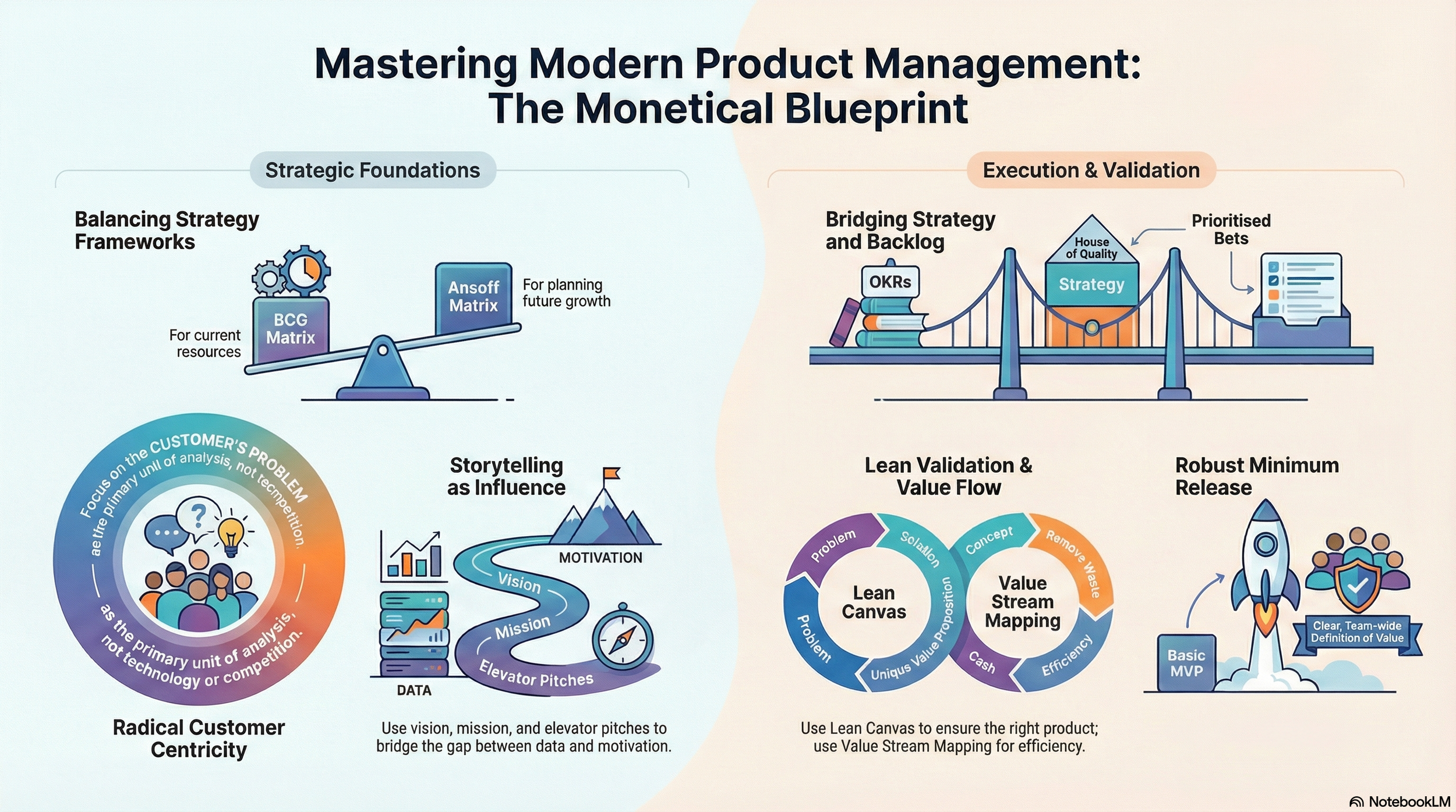
In the Generative AI era, the ease of feature creation often leads to "backlog bloat," where stakeholder requests overwhelm strategic intent. To combat this, high-performing teams utilise Objectives and Key Results (OKRs) as a strategic filter, bridging the gap between high-level company vision and daily execution.
To elevate this process beyond subjective prioritisation, Product Managers should employ the House of Quality. This tool is essential for the "hard" quantification of risk, effort, and business value. By using this framework to provide a holistic view for defining the product approach, prioritisation shifts from opinion to evidence-based decision-making.
"The backlog becomes a prioritised list of bets designed to achieve specific business outcomes."
When every item on the backlog is viewed as a "bet" rather than a guaranteed task, the team’s mindset shifts from merely delivering output to securing measurable outcomes.
The Power of Storytelling for "Influence Without Authority"
For a Product Manager, storytelling is not a "soft skill"—it is a core competency and a strategic tool for exercising influence without formal authority. In the face of lengthy initiative life cycles, the Product Manager must bridge the gap between cold data and human motivation.
This is achieved through the creation of hard strategic artifacts: the Vision, Mission, and the Elevator Pitch. These are not just words on a slide; they are the narrative threads that fuel excitement and maintain stakeholder alignment through the inevitable challenges of development. A master storyteller provides the "why" that keeps the team engaged when the "how" becomes difficult.
Building the Right Product vs. Building It Right
Resource management is often compromised when PMs confuse the validity of an idea with the efficiency of its execution. To avoid the efficient delivery of the wrong product, these concerns must be addressed in a strict sequence:
Validation (The Lean Model Canvas): This one-page tool deconstructs a business idea into its key assumptions. It answers the fundamental question: "Are we building the right product?"
Optimisation (Value Stream Mapping): Once the idea is validated, this visual tool analyses the flow of information and materials. It answers the operational question: "Are we building the product in the most efficient way?"
Validation must always precede optimisation. There is no greater waste than a highly efficient process that produces a product no one wants.
Moving Beyond the "Minimum Viable Product" (MVP)
The term "MVP" has become dangerously vague, often resulting in internal friction because teams cannot agree on a clear definition of "value." To resolve this, Monetical introduces the Minimum Release Strategy.
This methodology moves beyond the ambiguous "minimum" and provides a robust framework for defining the first value-driven deliverables. By establishing a clear, agreed-upon roadmap for initial releases, the Product Managers can maintain momentum and ensure that the "voice of the customer" is represented in every iteration, rather than being sacrificed for the sake of a fast launch.
Mastering these frameworks transforms a Product Managers from a tactical manager into a strategic leader. This evolution requires balancing internal performance with external drivers—using the BCG Growth-Share Matrix to manage current resources while simultaneously applying the Ansoff Matrix to plan for future growth. Furthermore, a strategic leader must look beyond the business walls, utilizing PESTLE analysis to monitor political, environmental, and economical factors that shape the product’s trajectory.
By integrating advanced methodologies like "Shift Left" strategies for early evaluation, you move from reacting to the market to defining it. In an era where technology changes daily, is your product strategy built on a foundation of features, or a foundation of human problems?
Here are the main Features that make up on the "Product Management 101 in an Era of Generative AI" program.
Strategic Planning Frameworks: The document contrasts the
BCG Growth-Share Matrix (for managing current resources) with the
Ansoff Matrix (for planning future growth), explaining how they work together to shape high-level product strategy.
Customer Centricity: This topic focuses on placing the customer's problem at the centre of every decision, moving beyond the idea that "the customer is always right" to understanding their functional, emotional, and social context. It also covers segmentation based on behavioral traits rather than just cohorts.
Storytelling as a Strategic Tool: The text highlights storytelling as a critical competency for "influence without authority," helping Product Managers bridge the gap between data and human motivation to compel stakeholders and engineers. This includes using templates for vision, mission, and elevator pitches.
Goal Setting & Prioritisation (OKRs): The document discusses using Objectives and Key Results (OKRs) to bridge high-level strategy with day-to-day execution, acting as a "strategic filter" for the product backlog.
Prioritisation Techniques: It introduces the "House of Quality" template to prioritise work by quantifying business value, risk, and effort.
External & Internal Analysis: The use of SWOT and PESTLE analysis is covered to ensure Product Managers monitor political, environmental, and economic factors to shape strategy.
Stakeholder Management: The text outlines the Product Manager's responsibility for maintaining stakeholder engagement, reaching agreement on aims, and using specific frameworks for effective communication.
Business Modeling vs. Operational Efficiency:
Lean Model Canvas: Used to validate if the team is building the right product by deconstructing business assumptions.
Value Stream Mapping: Used to analyze if the team is building the product in the most efficient way by mapping information and material flow.
Requirements & Release Strategy: This includes establishing a clear requirements management methodology and a "robust minimum release strategy" that goes beyond the traditional (and often ambiguous) Minimum Viable Product (MVP) concept.
Advanced Methodologies: The document lists advanced tools introduced to the team, such as the
S-Curve, TAM & TAS (Total Addressable Market/Serviceable Addressable Market), Adoption Curves, and Shift Left strategies.