
4 Surprising Ways a New Consulting Model is Changing the Game
Why Your Generative AI Initiative Is Likely to Fail
Many organisations face complex, high-stakes challenges, from executing a digital transformation to embedding a culture of innovation. Addressing these issues often requires specialised expertise, but traditional management consulting has become a strategic dilemma. The lengthy timelines, prohibitive costs, and project-based nature of legacy engagements are increasingly misaligned with the pace of modern business.
Monetical’s “digital consulting self-service” model is forcing a fundamental rethink of these old assumptions. This article moves beyond a simple comparison to break down a coherent strategic argument, revealing four ways this new approach is creating a powerful competitive advantage by redefining how companies access and embed expertise—moving from slow to fast, from temporary to sustainable, from generalised to specific, and from exclusive to accessible.
1. High-Impact Results Don't Require a Slow Start
Old Model: The Slow Ramp-Up of Analysis
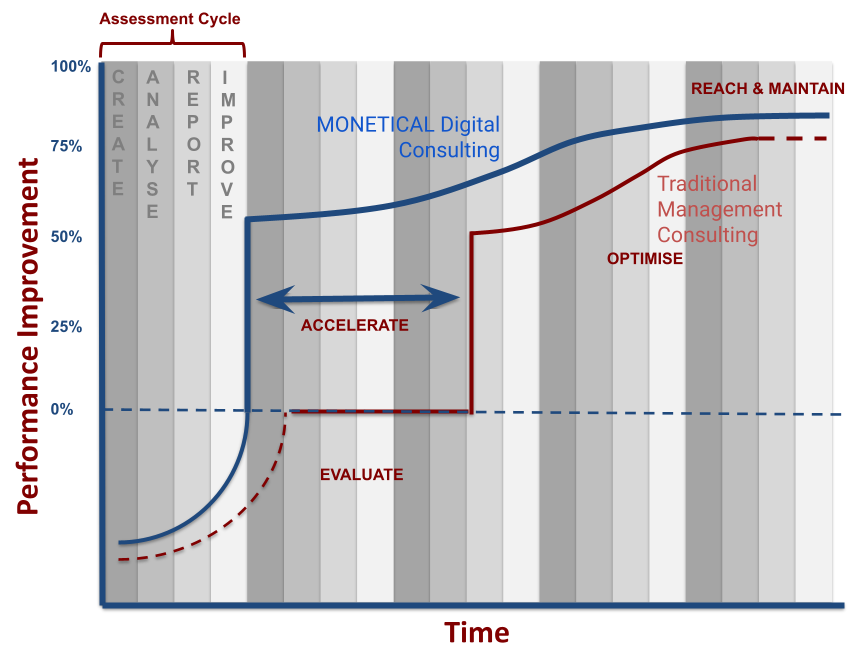
A conventional consulting engagement begins with a prolonged and costly evaluation phase. Consultants spend weeks, or even months, conducting discovery, interviewing stakeholders, and gathering data before any concrete improvements are implemented. As the traditional assignment cycle shows, performance stagnates during this initial period, delaying the return on a significant investment and consuming valuable time.
New Model: The Power of Immediate Acceleration
This new model renders the slow ramp-up obsolete, enabling a "quick-start turnaround" where performance improvement begins almost immediately. The acceleration is driven by a sophisticated two-step process. First, the model leverages the deep insights of internal staff who already understand the organisation's challenges, using its framework to rapidly qualify these existing perspectives. Second, this validated insight provides focus to more detailed performance evaluation, ensuring that expert analysis is immediately directed toward the areas that will drive the quickest and most meaningful gains. For any business, the ability to bypass the slow start and accelerate improvement builds a crucial competitive moat.
2. Expertise Shouldn't Have an Expiration Date
Old Model: The Knowledge Walk-out
A deep-seated frustration with traditional consulting is what happens when the project ends: the expertise walks out the door. The consultants depart, and the deep, contextual knowledge they provided is no longer on hand. This knowledge drain often leads to a decay in performance gains as the organisation struggles to navigate new challenges without the expert guidance it came to rely on.
New Model: Expertise as a Lasting Asset
In sharp contrast, Monetical ensures that access to its expertise knowledge base is continuous, even after a primary assignment cycle is complete. This transforms expertise from a temporary rental into a permanent organisational asset. This continuous access allows the organisation to maintain its performance improvements over the long term, building the capacity to adapt to "continuously changing enterprise and market conditions." This is a strategic shift from executing a one-time project to cultivating organisational resilience through an embedded culture of continuous improvement.
3. You're Accessing a Curated Network, Not Just a Single Firm
At the heart of this new model is not a fixed team of generalists, but a dynamic, curated network of subject matter experts and thought leaders. This structure provides organisations with an unparalleled depth and breadth of knowledge that a single firm can rarely match.
Instead of relying on a generalised approach, an organisation can tap into targeted, best-in-class knowledge for the precise challenge it faces. The experts in this network are accomplished leaders in their respective fields.
Critically, this network is not a static roster but a living ecosystem. The source states a core commitment: "Identification and appointments are greatly influenced by its clients’ needs and newly emerging operational and commercial topics of interest."
This client-driven evolution ensures the expertise available is not just world-class, but perpetually relevant and future-proofed against emerging business trends.
4. Top-Tier Knowledge is More Accessible Than You Think
Perhaps the most disruptive element of this model is its democratisation of elite expertise. Granting organisations access to world-class specialists at a "fraction of the cost of traditional management consulting approaches," breaking down the financial barriers that have historically placed top-tier strategic advice out of reach for many.
This affordability unlocks a powerful sequence of strategic benefits that build on one another:
Reduced cost of gaining access to experts
Immediate access to best-in-class expertise
Accurate industry benchmarking
Create a culture of continuous improvement
This isn't just a list of features; it's a strategic process. Reduced cost unlocks immediate access to expertise. That access empowers organisations to accurately benchmark their capabilities against industry best practices. This clarity, in turn, provides the foundation for creating a sustainable culture of continuous improvement. This accessibility levels the playing field, empowering more organisations to address their most challenging issues and build lasting competitive capability without a massive budget.
Conclusion: The Future of Expert Advice
The consulting landscape is undergoing a fundamental transformation. The legacy model of expensive, slow, and temporary engagements is becoming obsolete, ill-suited for the agility required in today's market. By leveraging digital platforms and dynamic expert networks, a new model is emerging—one that is more accessible, continuous, and ultimately more effective at building lasting organisational strength.
As expert knowledge becomes more fluid and accessible, how will your organisation adapt to turn it into a sustainable advantage?