
Gen AI Threat Versus Human Value in an Organisation's Future Success
Deconstructing Operational Vulnerability vs. Human Value
As we look back step back and synthesise the core research from the 2026 podcast series, which covered three core topics Generative AI, Product Management, and Enterprise Agility, we clearly see how an enterprise landscape is rapidly being reshaped by the abundance of AI compute, routine operational efficiency and basic code generation, which have become baseline commodities.
Sustainable market leadership no longer depends on the speed at which an organisation generates administrative artefacts, but on the depth, clarity, and adaptability of its human capabilities.
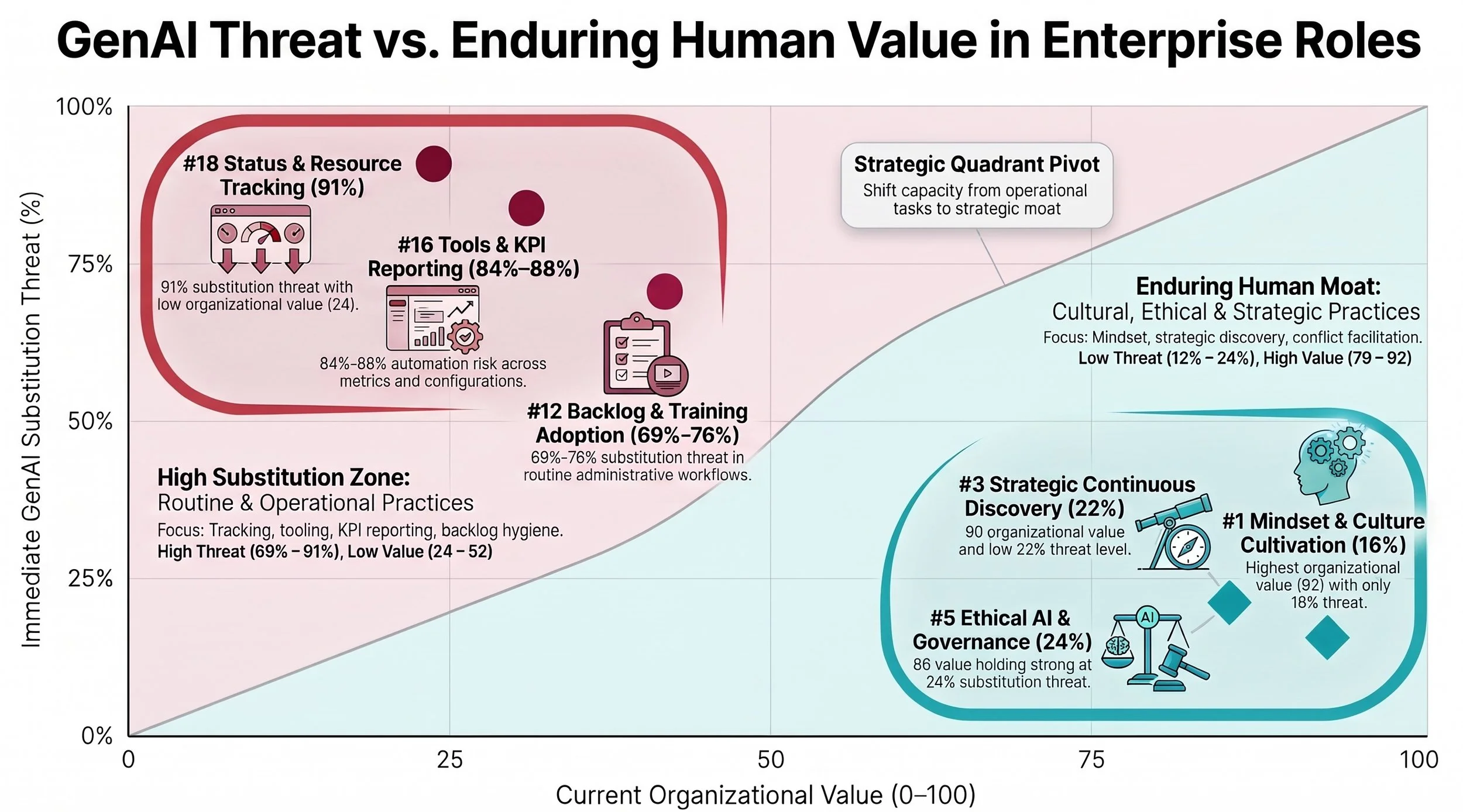
As generative artificial intelligence reshapes enterprise operations, organizational survival demands a decisive strategic pivot: transitioning capacity from routine operational task execution to human-centric value creation. The rapid evolution of large language models (LLMs) poses an immediate substitution threat to administrative, tracking, and transactional delivery functions.
Enterprise leaders who evaluate talent through task volume face rapid commoditisation and margin erosion.
To build a defensible competitive advantage, executive leadership must systematically reallocate organisational energy—shifting capacity away from high-threat, low-value administrative routines and reinvesting in resilient cultural, ethical, and strategic capabilities.
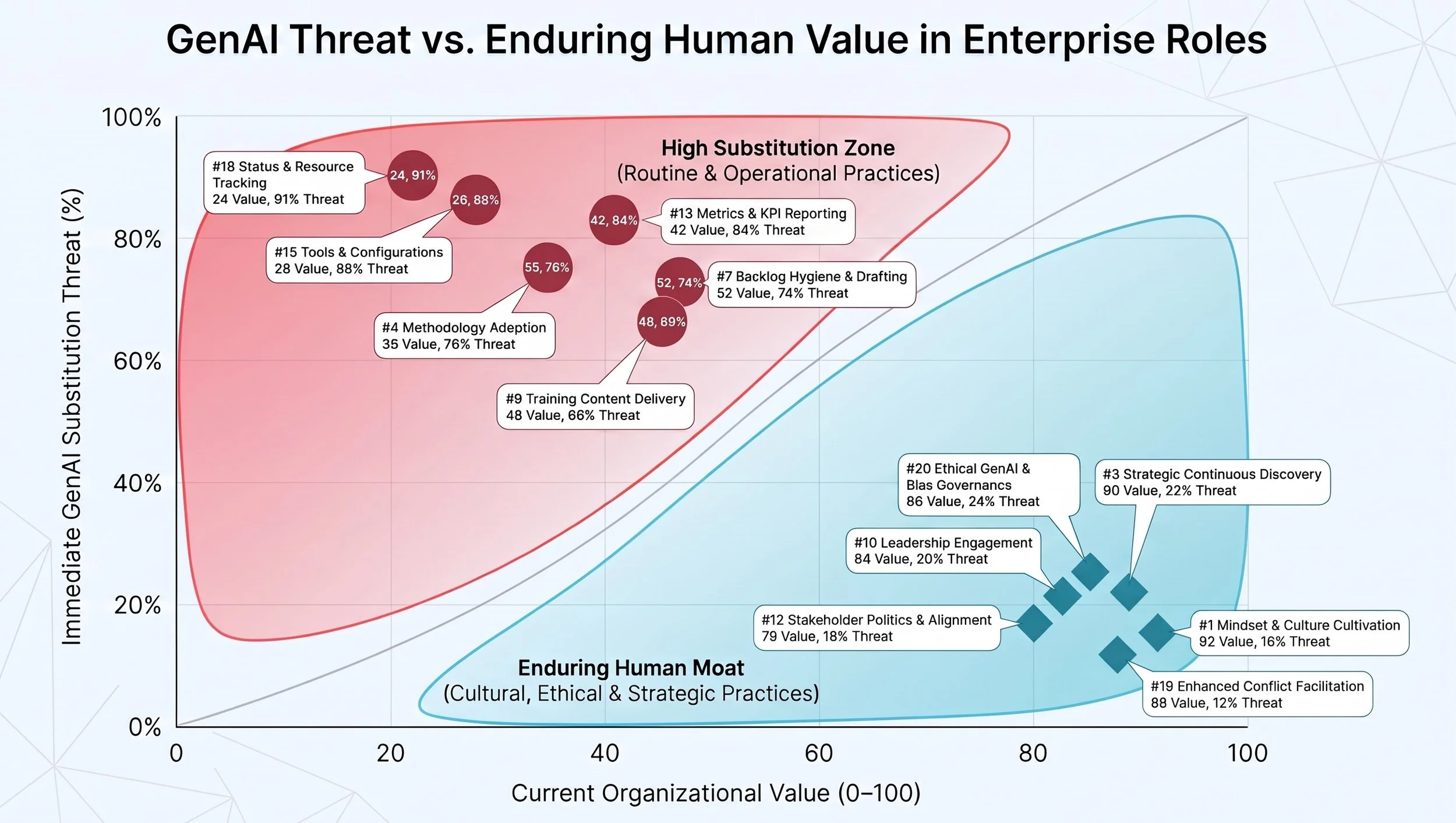
Empirical analysis reveals a stark polarisation across enterprise roles. On one side sits the High Substitution Zone, where routine operational practices—including Status & Resource Tracking at a 91% substitution threat, Tools & Configurations at 88%, and Metrics & KPI Reporting at 84%—carry high automation risk alongside low organisational value scores between 24 and 52. Automating these workflows without elevating human direction creates a structural trap called "mode collapse," dragging business outputs toward generic industry averages.
On the other side stands the Enduring Human Moat: cultural, ethical, and strategic practices scoring 79 to 92 in organizational value with only a 12% to 24% substitution threat.
This fortress is anchored by:
Mindset & Culture Cultivation (92 value, 16% threat),
Strategic Continuous Discovery (90 value, 22% threat),
Ethical AI & Governance (86 value, 24% threat), and
Enhanced Conflict Facilitation (12% threat).
By automating routine administrative tasks and systematically reinvesting organisational capacity into adaptive culture, continuous discovery, conflict facilitation, and proactive governance, enterprise leaders build an organisation designed to innovate, perform, and endure—shifting focus from execution speed to strategic intent.
1. The Strategic Quadrant Pivot:
Automating the Red Zone to Fund the Blue Moat
2. Cultural Leadership:
Closing the 95% Execution Vacuum
Empirical analysis across core enterprise practices reveals a sharp polarisation between automatable administrative routines and defensible human competencies. Organisations that continue to evaluate talent by task volume face rapid margin erosion as large language models (LLMs) absorb transactional delivery functions.
The following table contrasts the six high-vulnerability operational practices in the High Substitution Zone (69% to 91% immediate GenAI substitution threat; 24 to 52 organisational value) against the high-value domains that form the Enduring Human Moat (12% to 24% threat; 79 to 92 organizational value).
In 2008 Monetical's patent application “on automated data management for performance reports, surgical data architecture” demonstrated— hierarchical project memory and T-ratio statistical modelling—outperforms flat status tracking. However, automating operational tasks without elevating human direction leads to mode collapse. Because LLMs minimise prediction loss across public training data, unguided automation regresses business outputs toward generic industry averages. When code generation and status reporting are commoditised, competitive advantage shifts entirely to unarticulated customer insight, internal alignment, and cultural resilience.
Transitioning into this moat requires starting with the leadership and cultural infrastructure that determines whether AI investments scale or stall.
World Economic Forum (WEF) estimated up to 60% of Western professional roles face Generative AI impact. #1 Mindset & Culture Cultivation commands the highest organisational value in the enterprise framework (92 value score; 16% threat), paired with #10 Leadership Engagement (20% threat). Empirical evidence indicates that 95% of GenAI transformations fail due to a leadership vacuum, rather than inadequate compute or flawed models. Closing this vacuum requires three immediate leadership shifts:
Dismantle Command-and-Control Bottlenecks: Retire static 100-page consulting decks and pivot to hands-on internal capability building. Leadership rescued an initiative (i.e. NHS) by reclaiming strategic ownership and breaking delivery into continuous two-week execution slices.
Break the Pilot Success Trap: AI initiatives routinely fail at scale Leaders must ensure pilots are stress-tested against real operational friction and legacy dependencies.
Address Human Fear and Workplace Paradoxes: Executives must counter displacement (job replacement) fears through active listening, trust building, and strategic coaching—interpersonal capabilities algorithms cannot replicate.
Once an adaptive cultural baseline is established, organisations can address the interpersonal bottlenecks that intensify as AI accelerates delivery speed.
3. Collaboration and Alignment:
Governing Friction Before Delivery
As AI compresses development cycles, human alignment—not coding speed—becomes the primary operational bottleneck. #19 Enhanced Conflict Facilitation carries the lowest substitution threat across all evaluated domains (12%), while #12 Stakeholder Politics & Alignment holds an 18% threat alongside high organisational value.
To prevent cross-functional friction from derailing accelerated delivery, leaders must operationalise two alignment mechanisms:
The "Professional Prenup" (Team Working Agreements): Explicit Team Working Agreements lock in operational standards before delivery pressure hits across three areas: disciplined backlog management parameters to prevent scope creep, formal executive stakeholder alignment cadences, and mandatory pre-mortem risk discovery protocols.
Dynamic Change Management House of Quality: Leaders should deploy a tailored Change Management House of Quality that mixes structural mechanisms (governance and process alignment), psychological mechanisms (coaching and mindset development), and compliance mechanisms to match the specific transformation challenge.
With internal alignment secured, organisational capacity must be directed outward toward what to build next. Executing this strategic vision safely at AI speed requires embedding governance directly into the delivery lifecycle.
4. Strategic Direction:
Escaping Monoculture Through Continuous Discovery
When natural-language prompts can generate software components in seconds, the bottleneck shifts from execution speed to strategic intent. #3 Strategic Continuous Discovery delivers a 90 organisational value score against a 22% substitution threat, anchoring product strategy in three disciplined practices:
Reallocate Capacity to Unarticulated Struggles: Shift product effort away from #7 Backlog Hygiene & Drafting (74% threat) toward direct customer engagement, behavioral observation, and qualitative research. Generative AI can synthesise structured feedback, but it cannot observe latent user frustration or unarticulated market demand.
Apply 20 Foundational Product Filters and Shift-Left Orchestration: To stop AI speed from producing unnecessary features, every AI product concept should pass through 20 foundational product filters—including formal portfolio matrices and Value Stream Mapping (VSM)—before engineering resources are committed. Simultaneously, Shift-Left Product Orchestration is used to simulate Scope–Schedule–Budget trade-offs in real time and prototype functional tools via plain-language prompts.
Evolve PMs into Strategic Prompt Orchestrators: Product managers must act as strategic prompt orchestrators, establishing strict guardrails that preserve a distinct product identity - ensuring the initiative pulls product specs toward industry-average clichés, accelerating mode collapse and architectural monoculture.
5. Operational Integrity:
Bilingual Brokers, Ethical Guardrails, and Vibe Coding Discipline
Proactive AI governance is not a post-hoc compliance checkbox; it is an architectural prerequisite for scaling. #5 / #20 Ethical AI & Bias Governance combines an 86 organisational value score with a 24% substitution threat. Operationalising this integrity requires three structural safeguards:
Develop "Bilingual Brokers": Licensing third-party AI platforms without an internal strategy leads to unmaintainable API wrappers detached from business goals. Organisations need Bilingual PMs fluent in both commercial P&L objectives and technical model constraints—evaluating token economics, API deprecation cycles, and data residency requirements.
Mitigate "Vibe Coding" Risks: Natural-language software generation ("vibe coding") accelerates initial builds but creates a false sense of security that can mask architectural flaws and unhandled edge cases beneath working interfaces. Teams must pair natural-language development with strict prompt boundaries, systematic fact-checking, automated edge-case testing, and mandatory human architectural reviews.
Before scaling any deployment, organisations must also engineer a 5-Pillar Ethical Operating System across the following foundations:
Proactive production guardrails to catch inaccurate or non-compliant model outputs.
Value-Led Design principles ensuring technical initiatives serve explicit strategic goals.
Comprehensive bias governance protocols embedded across workflows.
Dual technical and commercial PMO readiness reviews prior to launch.
Continuous measurement of capability percentage uplift across enterprise roles.
To enforce this operating system at scale, teams should integrate four specialised AI governance agents into the software development lifecycle (SDLC): a Skill Readiness Agent, a Value Prioritisation Agent, a Merge Compliance Agent, and a Code Quality Agent, freeing human leaders to focus on strategic oversight.
6. Enterprise Action Matrix and Strategic Synthesis
Operationalising the Enduring Human Moat requires systematically pairing each high-threat administrative task targeted for automation with a concrete reinvestment in high-value human capability.
Moat Pillar
Target Competencies & Metrics
High-Threat Tasks to Automate
Concrete Organisational Action
Culture & Leadership
#1 Mindset & Culture Cultivation (92 Value / 16% Threat); #10 Leadership Engagement (20% Threat)
#18 Status & Resource Tracking (91% Threat / 24 Value)
Dismantle command-and-control decks; adopt two-week internal execution slices (NHS £1M+ rescue model); stress-test real operational friction and displacement fears upfront.
Interpersonal Alignment
#19 Enhanced Conflict Facilitation (12% Threat); #12 Stakeholder Politics & Alignment (18% Threat)
#15 Tools & Configurations (88% Threat); #13 Metrics & KPI Reporting (84% Threat)
Institute "Professional Prenup" Team Working Agreements (backlog rules, stakeholder cadences, pre-mortems); deploy a tailored Change Management House of Quality.
Strategic Discovery
#3 Strategic Continuous Discovery (90 Value / 22% Threat)
#7 Backlog Hygiene & Drafting (74% Threat); #4 Methodology Adoption (76% Threat)
Shift capacity to qualitative discovery of unarticulated customer struggles; enforce 20 product filters and Shift-Left Orchestration; use PMs as strategic prompt orchestrators.
Ethical Governance
#5 / #20 Ethical AI & Bias Governance (86 Value / 24% Threat)
#9 Training Content Delivery (69% Threat)
Deploy Bilingual Brokers; implement the 5-Pillar Ethical Operating System with four SDLC governance agents; enforce architectural reviews over "vibe coding."