
The Power of Tailored Change Management
Why One-Size-Fits-All Fails
The Paradox of Choice in Change
Organisations today are drowning in frameworks yet starving for results. We are witnessing a curious paradox in the corporate world: while initiative owners have access to an unprecedented library of change management (CM) models, most enterprises remain stubbornly wedded to a single, rigid "standard" methodology.
The choice of a change model should, in theory, be dictated by the unique nature of the initiative—whether it is a high-speed IT deployment or a deep cultural transformation. In reality, this is rarely the case. Too many organisations force every project into a pre-existing organisational mould, leaders are not just choosing a methodology; they are choosing to ignore the specific nuances that determine whether a project thrives or dies.

The Danger of the "Standard" Methodology
The traditional impulse to integrate a single methodology, e.g. PROSCI or ADKAR, because it has become the organisational standard creates hidden risks that only manifest once a program gathers pace. When the nature of the initiative is ignored in favour of a "book-standard" approach, the organisation faces increased oversight and a lack of agility.
True enterprise agility demands that framework selection be determined by the specific nature of the change—whether it is a process-driven optimisation, a culture-led shift, or a technology-heavy implementation.
Synthesis Over Selection: The Monetical Approach
The "Monetical Approach" empowers program leads to move beyond a single track, acting as a strategic synthesiser of the industry’s most robust models. By drawing from a vast toolkit—including Lean Sigma for process-heavy strategies, Jick’s Ten Commandments, Mento et al. (12-step model), and Shield’s focus on people-oriented success—organisations can tailor their response to the specific business value defined in their OKRs.
It’s paramount the each change management strategy creates a hybrid of the two critical factors:
The Leadership Side: Frameworks like Kotter’s Theory are leveraged to help leaders implement change. This includes critical phases such as Creating a Sense of Urgency [Aims & Goals], Forming a Guiding Coalition [People & Behaviours], and Communicating the Vision [Communication].
The Human Side: Simultaneously, the Bridges Transition Model is utilised to navigate the psychological and personal elements of the shift. This ensures that the transition is not just managed as a project, but as a human experience.
Navigating the "Neutral Zone"
According to the Bridges Transition Model, change is a journey through three distinct stages, each requiring a different operational focus. The Ending What Currently Is [Aims & Goals] phase must be acknowledged and managed before the organisation can move forward.
The most treacherous phase is The Neutral Zone [Plan & Execute]. This is the space between the old ways and the new beginning where uncertainty thrives and initiatives often stall. Success here depends on the execution of specific "Ways of Working" that guide the workforce toward The New Beginning [Ways of Working]. If this zone is not managed with precision, the initiative will fail to deliver its intended business value.
As such, Monetical ensures the appropriate Features, which represent the individual adoption of a specific Framework Activity, are available for review, planning and adoption. Each Framework Activity is available as a Community Consulting Advice, which is assigned to the Initiative Program Product Backlog.
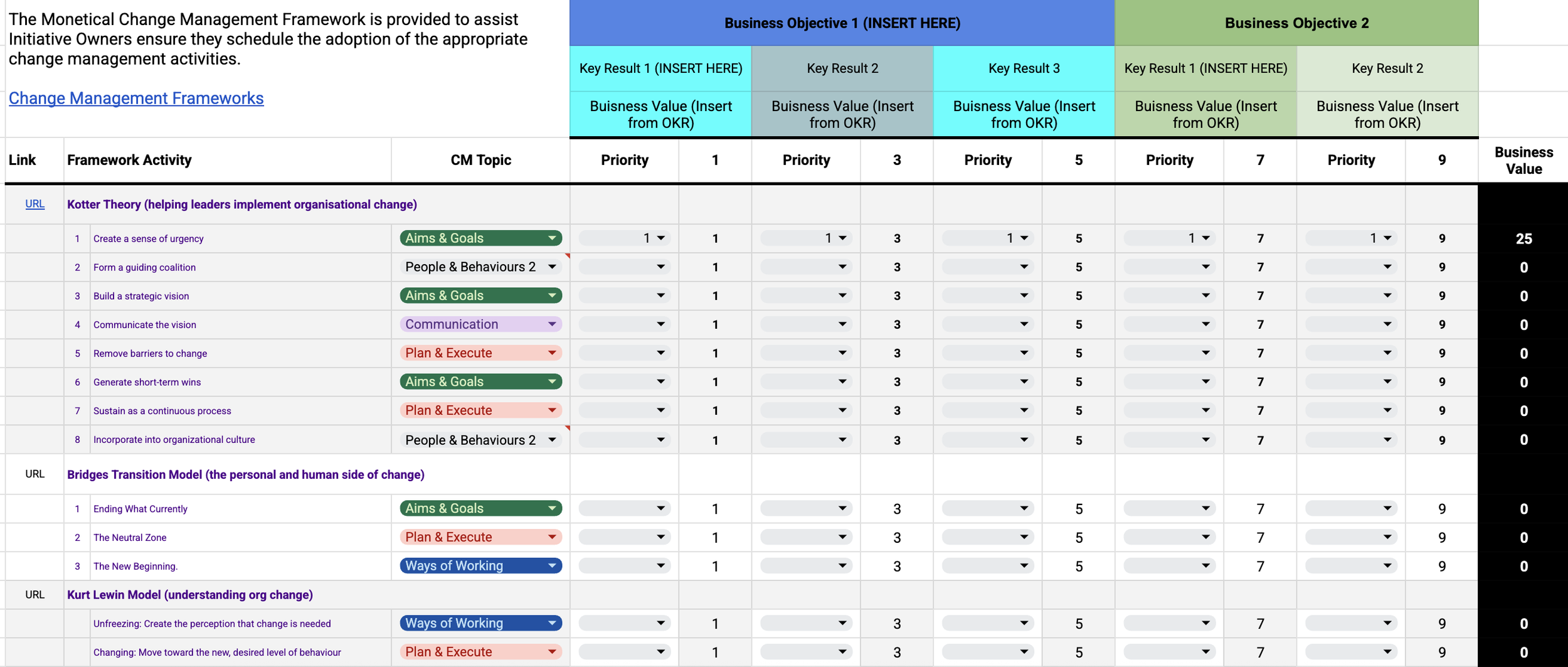
Change Management Assessment Against Program OKRs
Moving from "Exception" to "Org DNA"
The ultimate vision of a strategic "Enterprise" approach is to move beyond managing change as a series of isolated, one-off projects. The goal is to institutionalise change management practices so a living process, which are constantly assessed throughout the initiative life cycle.
To move change from an "exception" to the "Org DNA," organisations must follow a deliberate, eight-step maturity path:
Institutionalise change management practices, processes, and capabilities.
Build organisational CM capability and competencies [People & Behaviours].
Deploy CM broadly throughout the enterprise [Plan & Execute].
Ensure CM is second nature [Plan & Execute].
Establish CM as a Standard Operating Procedure [People & Behaviours].
Ensure CM is the norm for all projects and initiatives [Plan & Execute].
Shift the culture so CM is an expectation, not an exception [Ways of Working].
Ensure employees have internalized their role in leading change [People & Behaviours].
The Path to Enterprise Agility
Transformation is not a linear process to be "managed" by a rigid checklist; it is a complex evolution that must be orchestrated. By shifting from process-heavy compliance to a tailored strategy anchored by Objectives and Key Results (OKRs), organisations ensure that every change activity—whether drawn from Kotter, Lean Sigma, or Bridges—is purpose-built to deliver measurable business value.
As you evaluate your current portfolio, you must ask: Is your framework serving the unique nature of your initiative, or are you merely following a "standard" that has outlived its usefulness? The future belongs to organisations where change management is not a task, but a part of the cultural fabric—second nature, expected, and internalised.